January 2026 is National Stalking Awareness Month.
WHAT IS STALKING? While legal definitions of stalking vary between jurisdictions, a good working definition of stalking is: a pattern of behavior directed at a specific person that would cause a reasonable person to fear for their safety or the safety of others or suffer substantial emotional distress.

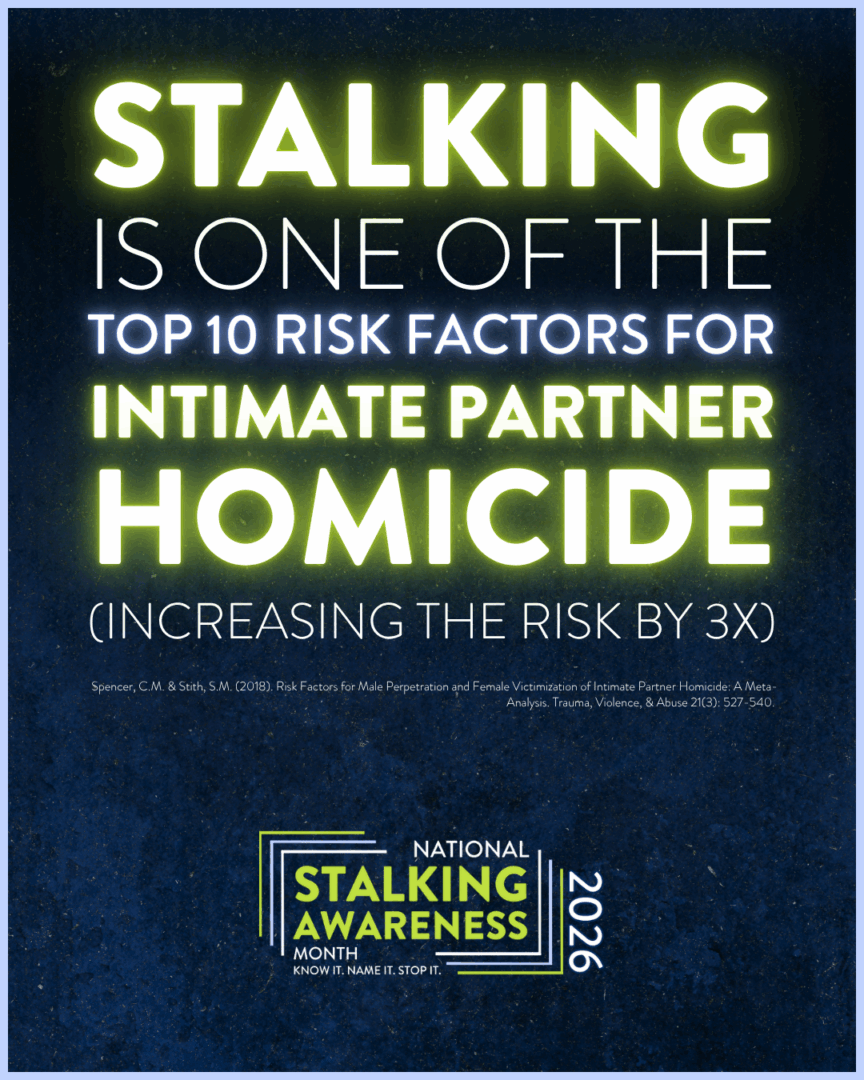
• An estimated 13.5 million people are stalked in a one-year period in the United States.
• Nearly 1 in 3 women and 1 in 6 men have experienced stalking victimization at some point in their lifetime.
• More than half of all victims of stalking indicated that they were stalked before the age of 25, and nearly 1 in 4 were stalked before the age of 18.
• The vast majority of stalking victims are stalked by someone they know: 40% by a current/former intimate partner, 42% by an acquaintance. • 69% of female and 80% of male stalking victims were threatened with physical harm.
• People aged 18-24 experience the highest rate of stalking victimization (among adults).
• Stalkers use many tactics, including making unwanted phone calls and approaching the victim or showing up in places when the victim does not want them to. Following and watching the victim. Sending unwanted texts, photos, emails, and messages through social media. Sending unwanted gifts. Using technology to monitor, track, and/or spy on the victim.
• Almost half of stalking victims experience at least one unwanted contact per week.
• 11% of stalking victims have been stalked for 5 years or more.
• More than twice as many victims are stalked with technology than without.
ALA. CODE § 13A-6-90 (2025). STALKING IN THE FIRST DEGREE
(a) A person who intentionally and repeatedly follows or harasses another person and who makes a threat, either expressed or implied, with the intent to place that person in reasonable fear of death or serious bodily harm is guilty of the crime of stalking in the first degree.
(b) The crime of stalking in the first degree is a Class C felony.
ALA. CODE § 13A-6-90.1 (2025). STALKING IN THE SECOND DEGREE
(a) A person who, acting with an improper purpose, intentionally and repeatedly follows, harasses, telephones, or initiates communication, verbally, electronically, or otherwise, with another person, any member of the other person’s immediate family, or any third party with whom the other person is acquainted, and causes material harm to the mental or emotional health of the other person, or causes such person to reasonably fear that his or her employment, business, or career is threatened, and the perpetrator was previously informed to cease that conduct is guilty of the crime of stalking in the second degree.
(b) The crime of stalking in the second degree is a Class B misdemeanor.
ALA. CODE § 13A-6-91 (2025). AGGRAVATED STALKING IN THE FIRST DEGREE
(a) A person who violates the provisions of Section 13A-6-90(a) and whose conduct in doing so also violates any court order or injunction is guilty of the crime of aggravated stalking in the first degree.
(b) The crime of aggravated stalking in the first degree is a Class B felony.
IF YOU BELIEVE THAT YOU ARE A VICTIM OF STALKING CONTACT YOUR LOCAL LAW ENFORCEMENT AGENCY
ALA. CODE § 13A-6-91.1 (2025). AGGRAVATED STALKING IN THE SECOND DEGREE
(a) A person who violates the provisions of Section 13A-6-90.1 and whose conduct in doing so also violates any court order or injunction is guilty of the crime of aggravated stalking in the second degree.
(b) The crime of aggravated stalking in the second degree is a Class C felony.